Friday, July 27, 2012

Kansas

We now reckon that if America had a zipper up the middle, that’s just where we are zipping along up I-35 & 1-135 with lots of open space on either side of the highway. All the corn is in with the stubble waiting to be burned, but because of the heat - 10 degrees warmer than usual, with usual being 92F – for the past three weeks we’ve been living in 100F heat and no sign of it cooling down. We consciously picked this time of the year to explore the heartland to avoid the height of the tornado season; now it’s too hot for tornados as they need both hot and cold air colliding to form. We are both still happy with our decision.

Our only stop in Kansas was in a town called Salina, not too far from Abilene the birthplace of President Dwight David Eisenhower whose museum we visited – which was the whole purpose for this stop. The afternoon we arrived we drove to downtown Salina as we needed to go to a Bank of America to get some cash; we have a new appreciation of ATM’s as we discovered that the branch closes at 4pm - a touch of the Greeks about the length of a work day! We visited a coffee shop/book store but no Brittani or Brad at this coffee shop.
The next day we drove the 50 miles to Abilene and the Dwight David Eisenhower museum which is located on the land where Eisenhower’s childhood home stands; here Ike’s parents raised their six sons. All the furniture including the radio is authentic. The grounds now host the museum, library, meditation chapel (where Ike, Mamie and their son Dwight are buried), a visitor center and the ancestral home which was acquired shortly after the death of Ike’s mother in 1946. As some of the exhibits had been removed due to ongoing renovations we started our tour with WW11 and learned a lot; Adele was fascinated at how they constructed a floating harbor off the Normandy coast in just six days, what a clever idea! D-Day was in planning for more than 2 years when the floating harbor idea was conceived of - it took months to fabricate all the parts, and then when the assault was to start the weather was too bad so they had to wait two days - must have been the longest 48 hours for all involved. There were lots of photos of General Eisenhower meeting the Allied leaders and of the assault landing – think Saving Private Ryan. Ike was rightly feted as a hero with ticker tape parades in all cities’ he visited on returning to the US.

We then learned the history of how both the Republican and Democratic parties wanted Ike for to stand for President and how he ultimately “stole” the Republican nomination. Mamie was almost as popular as Ike and quite a number of her outfits on display - she was voted as one of the best dressed women many, many times.  A little story about Mamie we read was about a visit to Paris during which the dress designers were annoyed that she would not buy her cloths there; she was reported to have said that she would not pay $300 to $500 for a dress in Paris when she could get a nice dress for $17.95 in America! She always looked a million dollars in her outfits. 
Looking through the pictures and letters of Ike's Presidency he certainly spent a lot of time on Cold War issues thus preventing a war between Russia and the USA; it looked ominous for the world after WW11 when the nuclear bombs were a real scare. An interesting facet of Ike was that just like George VI in England he was not comfortable in front of a television camera; ever the strategist he saw TV was the new medium and exploited it to get his message across to the people. One of his advisors came up with the clever idea of having the cameraman hidden under a black sheet with a hole for the camera lens, the President was therefore not too conscious of the camera. There are lots of family photos including their grandchildren having birthday parties at the White House and cycling on the lawn.  Mamie was a very busy First Lady and very popular.

We watched his farewell speech from the White House in which he prophetically warned against “the military/industrial complex” in the same section is a plaque with an excerpt from one of John Adams speeches (photo to follow).
The Abilene Visitors Centre is housed in the old railway station – at the other side of the tracks from the Eisenhower Museum – this was our next stop to see if we could take the trolley tour, sadly not as it only operates on Saturday’s at 2pm & 4pm. We had been hoping to be driven around town as, at 103F it was too hot to walk. Instead we settled for a really nice meal in Kirby House, a restaurant in a restored Victorian house where we were served by a jolly very pregnant waitress.

Sunday, July 22, 2012

Guthrie,OK


Statue commerating the marriage of Miss Indian Territory to Mr Cowboy Oklahoma
establishing the Sate of Oklahoma State

The inside of an old Drugstore - in 1910 more alcohol
was sold as medicine than in bars 

An interesting advertisment - now you know where the word came from! 

One of the many beautiful buildings in Guthrie 

A sandstone building

 Coffee anyone?

On Route 66 once again 
Posted by Picasa

Oklahoma City and Guthrie

Not originally planned as a part of our itinerary, but added after we met Frances and Don in Branson, MO Oklahoma City was a big surprise beginning as we drove from the east to see the city with modern skyscrapers and many beautiful new structures silhouetted against the western sun. We had arranged to meet Frances and Don for lunch in the restaurant of the Cowboy Museum which was very close to our RV Park and were delighted to visit with them and meet their 4 year old granddaughter Hannah. The museum is a really imposing very modern building with gorgeous landscaping that has a huge entrance hall and a foyer with a recessed area in which there’s a plaster statue 18 feet tall, on an 8 foot plinth of an Indian on horseback titled "The End of the Trail". The statue was made for San Francisco's 1915 Panama-Pacific International Exposition; in 1920 the city of Visalia, California, obtained the discarded statue and placed it in Mooney Park where it remained in a gradually deteriorating condition for 48 years. In 1968 the National Cowboy & Western Heritage Museum acquired the plaster statue, restored it to its original magnificence and made it a focal point of the museum.

The museum has a big section dedicated to Cowboy heroes of the Silver Screen with of course, John Wayne, Gene Autry, Robert Redford, Paul Newman, Tom Mix, Charlton Heston, Roy Rogers and Hop Along Cassidy to name but a few; also displayed were the outfits they wore and other memorabilia from their movies.   There’s a scaled down Rodeo Arena and movies of different competitions; a section on working cowboys, lots of saddles, bridles and barbed wire. We learned that cattle were driven many hundreds of miles to the railway (for 75 cents a head) for onward transportation to Chicago and points east. There was also a section devoted to the military in the west, mountain men and Native Americans; all very well put together. The art section displayed items from an annual competition - artists are invited to compete – all of the art was for sale so…as you can imagine it was wonderful; there’s also a permanent collection which is excellent.
The following day we drove into the city and took the trolley to the Oklahoma City National Memorial, dedicated to the 168 victims and the survivors of the April 19, 1995 bombing of the Murrah Federal Building. The grounds where the building stood are beautifully laid out; it has a reflecting pool with an arch at either end, one inscribed with 9.01 and the other 9.03 - the bomb went off at 9.02 which changed our world. A moving and poignant feature is the field of chairs with a chair for each person killed name inscribed, there are smaller chairs for the 19 children killed. There’s a rescuers orchard surrounding the Survivor Tree - this tree was in the middle of the car park for the Federal Building – was badly damaged in the blast, yet managed to survive. Inside the museum all the TV coverage, photos and stories of the people lost, sadly some families lost children and a parent. The second floor housed the nursery and was right at the epicenter of the blast, most of you will remember the footage of a fireman with a little girl in his arms which became a symbol of the tragedy, she died on the way to hospital. Our visit there was a moving and heartbreaking experience!

Afterwards we caught the Trolley back to a part of the city that’s being redeveloped and gentrified called Bricktown, really well done with a mix of old warehouse buildings and new buildings on the sides of a 4 foot deep canal that twists and turns through the area. There are restaurants, shops, a cinema, apartments and a lovely walkway with bridges to cross the canal, trees, shrubbery and little gardens. At the end of the canal is a really massive display of larger than life sculptures depicting the land rush west of the late 1800’s. This took a local sculptor 20 years to put together. Believe it or not we stood in line, in 100F heat to take a boat ride on the canal! This is the nicest redevelopment project we have seen.

On Sunday we drove 30 miles north to Guthrie the original capital of Oklahoma a local newspaper editor was stridently critical of the governor whereupon the governor said he would see Guthrie reduced to dust and moved the capital to Oklahoma City. We took a self-guided walking tour (on the shady side of the street) and commented that small towns in the Midwest are built to last with all the buildings made of brick, nice architecture and built to complement one another.  We wandered into a coffee shop out of the heat and started chatting to our host Brittani while ordering our coffees, recognizing our Irish accents she told us that she and her family are going to Ireland next year and asked for our advice on what to do, see and how to get there. We then started a conversation with Brad, a published author, who is writing a western trilogy. He has been to Ireland and other parts of Europe - we promised to keep in touch. As we were leaving the coffee shop Brad suggested that we should take a little diversion on our way back to a cafe called Pops. What a surprise? This is a store with walls of glass and glass shelving displaying thousands of bottles of soda, in hundreds of varieties and colors from all over the world. It also has the largest freestanding canopy in the world.
And, where is Pops? In the middle of nowhere, near a town called Edmond right up tornado alley! We had a great few days in Okie!

Oklahoma


"End of the Trail" National Cowboy & Western Heritage Museum

Field of Empty Chairs - Oklahoma National Memorial & Museum

The Gates of Time and the Reflecting pool

Objects and memories hung on a surounding fence 

On a water-taxi on the canal in Bricktown 

The Western Rush  
Posted by Picasa

Hot Springs


Some of the equipment in a bath house,
In the backgroung steam baths,
In front hoses to hose one down,
Through the door a sitdown bath like a chair.

A needle shower

The center piece in the mens changing room

A place to relax on the top floor 

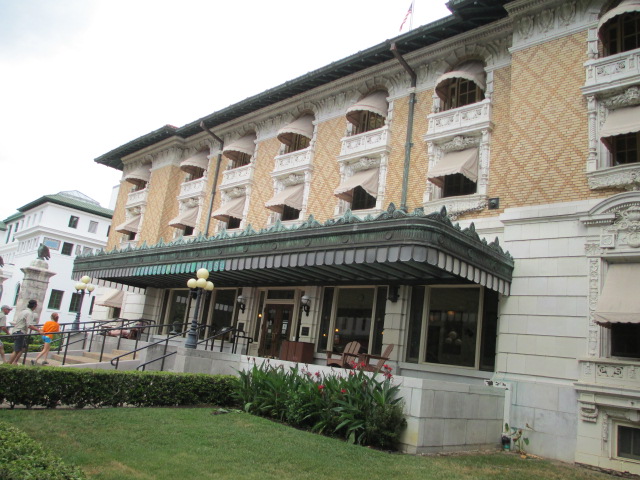
The Fordyce Bathhouse 

One of the 140F Hot Springs
Posted by Picasa

Thursday, July 19, 2012

Little Rock and Clinton Museum


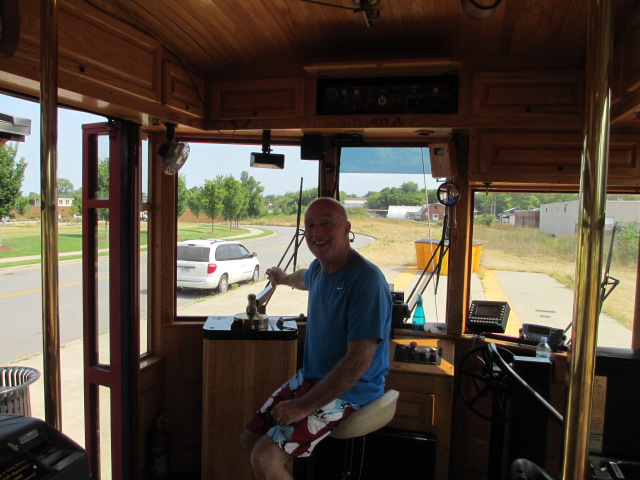
 Tom driving a tram!

A gift from Korea to Little Rock 

Adele heading into the Oval office 

Clinton Museum design based on Trinity Library, Dublin
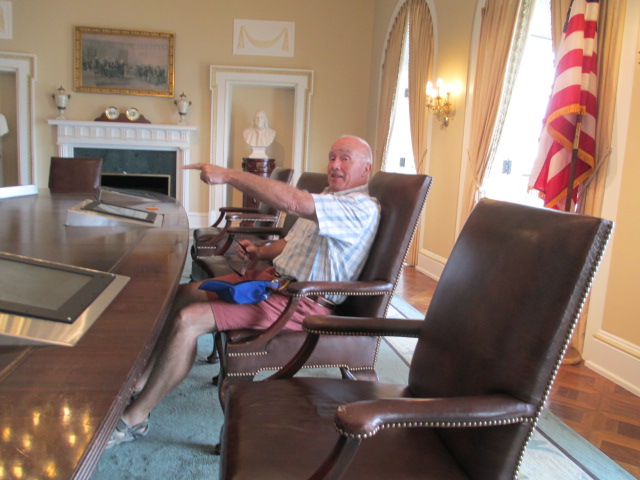
Giving orders in the Cabinet Room 

The Duck March
Posted by Picasa

Tuesday, July 17, 2012

Oklahoma

"Oklahoma! - where the waving wheat sure smells sweet; and the wind comes right behind the rain!" 

Since starting out on this odyssey in late October 2010 we have travelled 17,000 miles in the RV and have no idea of how many miles in “bluebug”. Oklahoma is state number 39 visited of the lower 48 and believe or not we are still enjoying ourselves, experiencing the vastness and diversity of America, learning lots, meeting wonderfully interesting people and literally lucking out, big time in some of the places we had not known of before receiving a recommendation from a new acquaintance. Our first stop was at Sallisaw, just over the border from Arkansas, in a small but nice KOA RV Park - with a pool – an absolute must in the heat we’re experiencing. Thankfully, the nights cool down sufficiently to allow us take a mile walk after dinner; we enjoyed being able to do that.

Sallisaw is in the historical Indian Territory and from there we drove to Muskogee to visit the Five Civilized Tribes Museum; the tribes were Cherokee, Chickasaw, Choctaw, Creek and Seminole. These people who lived in southeastern US had taken on the Colonial lifestyle, owned their homes, had beautiful furniture, some even owned plantations and had slaves; generally they enjoyed a luxurious lifestyle. Over time, wishing to be good citizens and assimilate into the colonial culture, they negotiated several treaties with the government but were tricked by the politicians of the day…nothing changes! When the Europeans originally came to the “new world” there were an estimated 12.5 million Native Americans, by the end of the 19th century there were a little more than 250,000. Disease(s), some deliberately introduced – think smallpox – almost decimated them; others were killed in wars and many died in various “relocations”. Similar to many older civilizations their history was passed on orally which meant that they did not read or write and had no alphabet of their own, so were easily tricked. A genius named Sequoyah (yes the tree is called after him) took twelve years to develop an alphabet of 86 letters that would have all the diphthongs of the various Indian dialects. In 1907 Miss Indian Territories married Mr. Cowboy Oklahoma to form the State of Oklahoma.
The Curator at the Muskogee museum recommended that we should visit the Cherokee National Museum in Tahlequah which was only a 20 mile drive away. Which we did to discover a beautiful new museum built on the grounds of a Native American girl’s boarding school. The museum entrance included a guided tour of a Cherokee village; our guide a Cherokee man, with hair to his waist and wearing traditional hide pants and vest. This was a fascinating experience as each family had a summer house (with plenty of ventilation) and right next door, a winter house (where hardly a breeze could get in the door) the houses were constructed of wattle and mud with bamboo and grass roofs. On a playing field there was a group of boys and girls playing stick ball; so similar to Lacrosse that one wonders if this is where lacrosse originated. We also watched a man instructing younger men in the making of flint arrow heads and a lady making baskets, all were dressed in the traditional way. In the center of the village is the meeting house from where the elders of the tribe (male and female) govern, they meet each evening. Similar to a number of ancient civilizations the Cherokees is a matriarchal tribe, with the blood line going through the mother. Another interesting societal issue we learned is that the mother’s clan is responsible for the rearing of the children. The medicine man was a very important member of the village as he had cures for many ailments; some native cures looked like they would be much safer than the snake oil and potions being sold by quacks to the white man.

Inside the museum there’s a very good exhibit detailing the "Trail of Tears" - the forced relocation of the Five Civilized Tribes to lands west of the Mississippi during one of the coldest winters on record. The people were not allowed bring any possessions with them – this was in effect a forced march, they had no extra clothing and soldiers on horseback pushed them forward all the time.  Many (some estimates are as high as 25%) died on the trail; of starvation, the cold but mostly of heartbreak. These poor people were now so isolated, far from their ancestral lands, their burial grounds and their ancestors for most this was the greatest sorrow. Not an inspiring story of the early settler, yet all part of the fabric of US history. Then when they had settled down in “The Indian Territory” their children were taken from them at age three and sent to boarding schools for the next thirteen years ((with no vacations) to be educated in the white man’s traditions and teach them a trade; afterwards they could decide if they wanted to return to their tribe or join the white man’s world. Native Americans had a highly developed society, laws and a democratic form of government, and where self-sufficient. They could not understand the concept of owning the land as man is only here on earth for such a short time, they believed that we must protect and respect the land, rivers, skies, birds, fish and animals – surely the first environmentalists!